The History
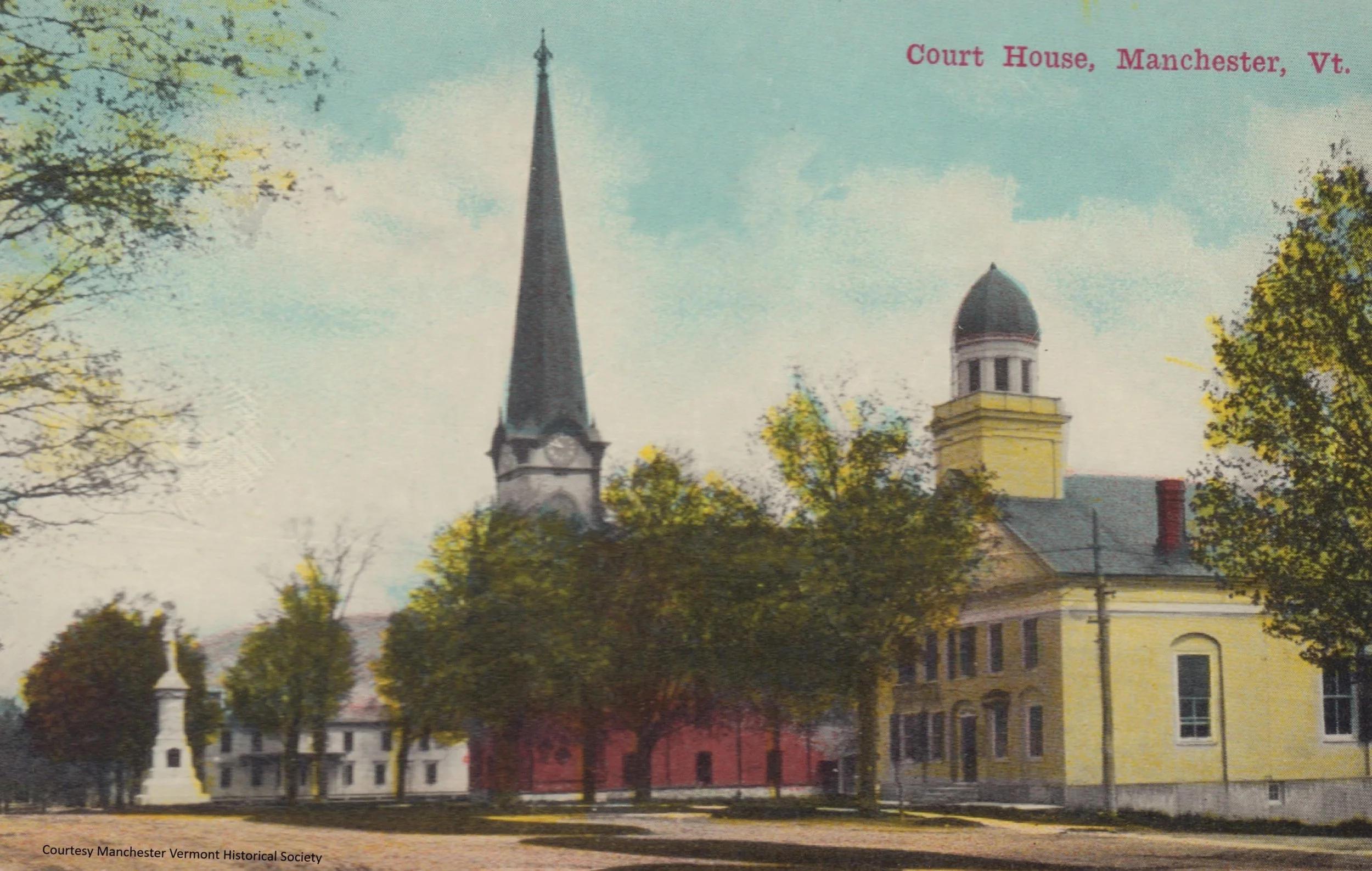
Since the decision by Manchester’s citizens to build it in the early 1800s, the Courthouse has served as the center of civic and municipal life in Manchester. It has stood at the heart of events that touched so many in our community, including bell ringing during the pandemic in 2020. The story of the Northshire and its people is imbedded in this beautiful landmark, so worthy of preservation.
Manchester Prior to 1822
A two-acre meeting house “lott” was laid out when the town was surveyed in 1764. It is located in the Village where the present Congregational Church and Courthouse stand. The first meeting house was built on the northern end of the lott between 1779-1784.  A schoolhouse once stood between what is now the Congregational Church and the Courthouse, but was moved to West Road in 1870. Apparently, horse sheds and various other buildings that are now gone occupied the area, as well as an early cemetery. (2)

Nearly all who died in Manchester during the first 25 years were laid to rest in unmarked graves on their own property. Many interments prior to 1791, however, were made in a burial ground provided for by the original Proprietors in the two-acre “meeting house lot” forty rods long by eight rods wide. This cemetery occupied space now covered by the Courthouse and that section of Union Street adjacent to it, including many who fought in the Revolution. (2)
In 1781, the Vermont General Assembly created Rutland and Bennington Counties along their present boundaries. The selection of county seat was left to the counties themselves. In Bennington County, the task was assigned to a commission and the matter soon became mired in controversy. Of the 17 towns in the county, several wished to be the designated shire town, but Bennington and Manchester were loudest and most persistent. No compromise could be reached. Finally, the Commissioners made each town a half shire town and decided that each would have a county court house. The decision was confirmed by an act of the Assembly which also required that a courthouse and jail be built in each town. (3)
In 1788, before the present courthouse and jail were built, Governor Chittenden and his Council joined Legislative Sessions in the original Manchester meeting house. For a “fleeting moment”, Manchester took its place among the capitals of the world, as Vermont was still an independent republic and would not be part of the United States until 1791. (1, 5)
In the 1790s, the commissioners settled on a site that is now roughly in the middle section of Equinox Junior where a small courthouse and jail were built. Initially, summer court was held in Manchester, and winter court in Bennington.
As late as 1803, perhaps a little later, the town whipping post stood in front of the northern portion of the present Equinox, and floggings were administered there. The pillory stood on the Common, opposite, and was used during the first decade of the 1800s. These were used in the days when the sheriff was as apt to cut off earlobes or brand foreheads or mete out any other kind of punishment. (1)
By the beginning of the nineteenth century, the cemetery directly south of the original meeting house had become uneven with graves and sadly neglected. Though many small headstones still stood, military recruiting officers for the war of 1812 removed them, leveling the surface to create a parade ground where horses and men could muster. The remains of many early settlers were disinterred and placed in a new burial ground at the south end of the village, just inside the north gate of Dellwood Cemetery. (6)The Present Courthouse Structure
1822
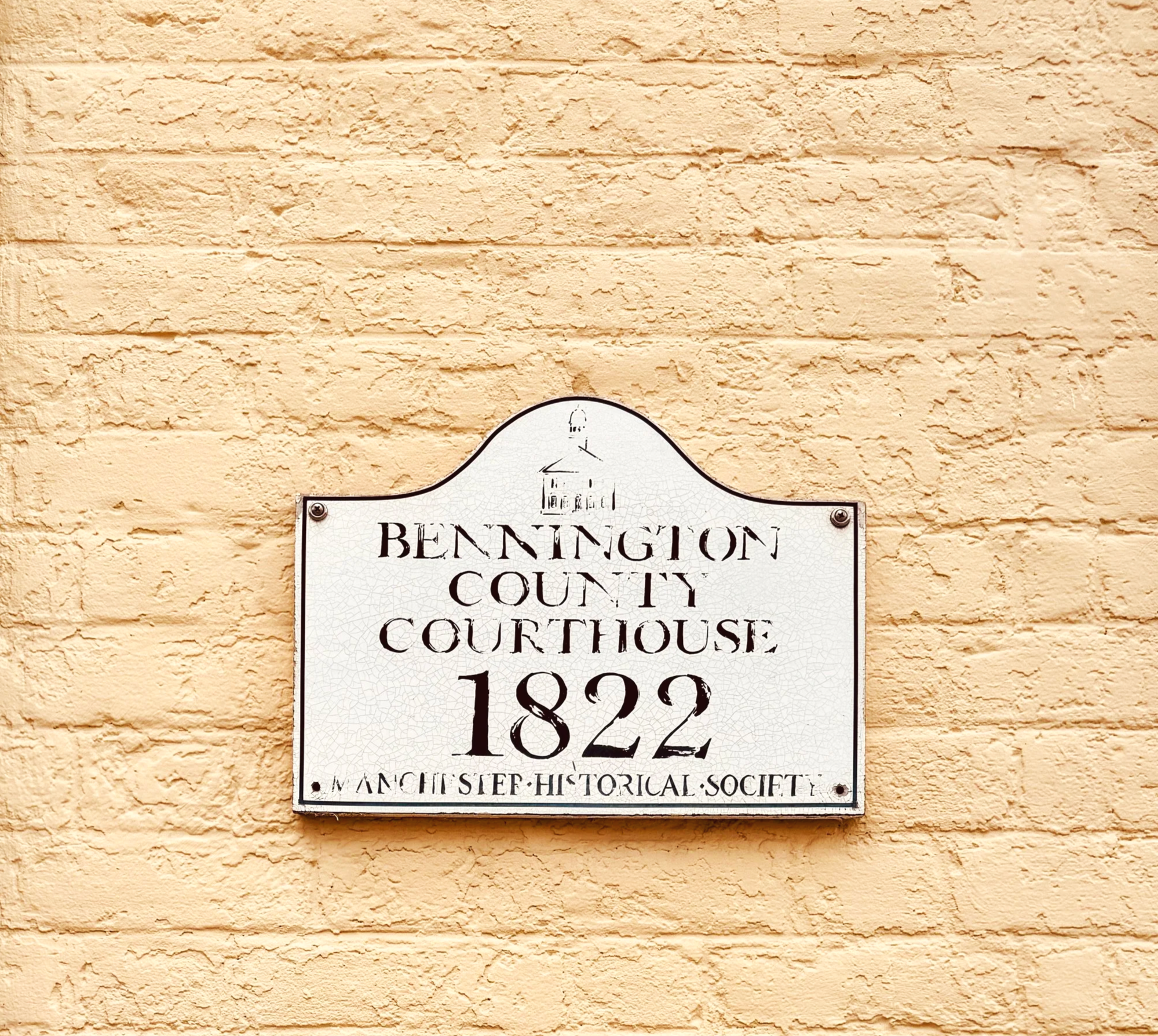
After the precedent-setting wrongful murder case of a Manchester citizen in which Stephen Boorne was sentenced to hang (later reversed), it was decided that a larger, more elaborate courthouse building was needed. The site chosen for the new Federal-style courthouse was the former cemetery, the location of the parade grounds used in 1812. Private funds were raised, and the current two-story brick structure was built.
1849
An addition was built on the east side of the new building. This enlarged the courthouse and, at the same time, exterior renovations included a new cupola. This work was accomplished at County expense, but with no conveyance of land, the county courthouse still occupied part of the “meeting house lot.”
1890
An addition required the purchase by the county of a strip of land from Equinox Hotel Company.
1901
Improvements were authorized by the Legislature, and at this time, two stories were added at the east end of the building. Subsequently, a slate roof was added, a furnace was installed, and rooms for judges, lawyers, and jurors were constructed.
1907
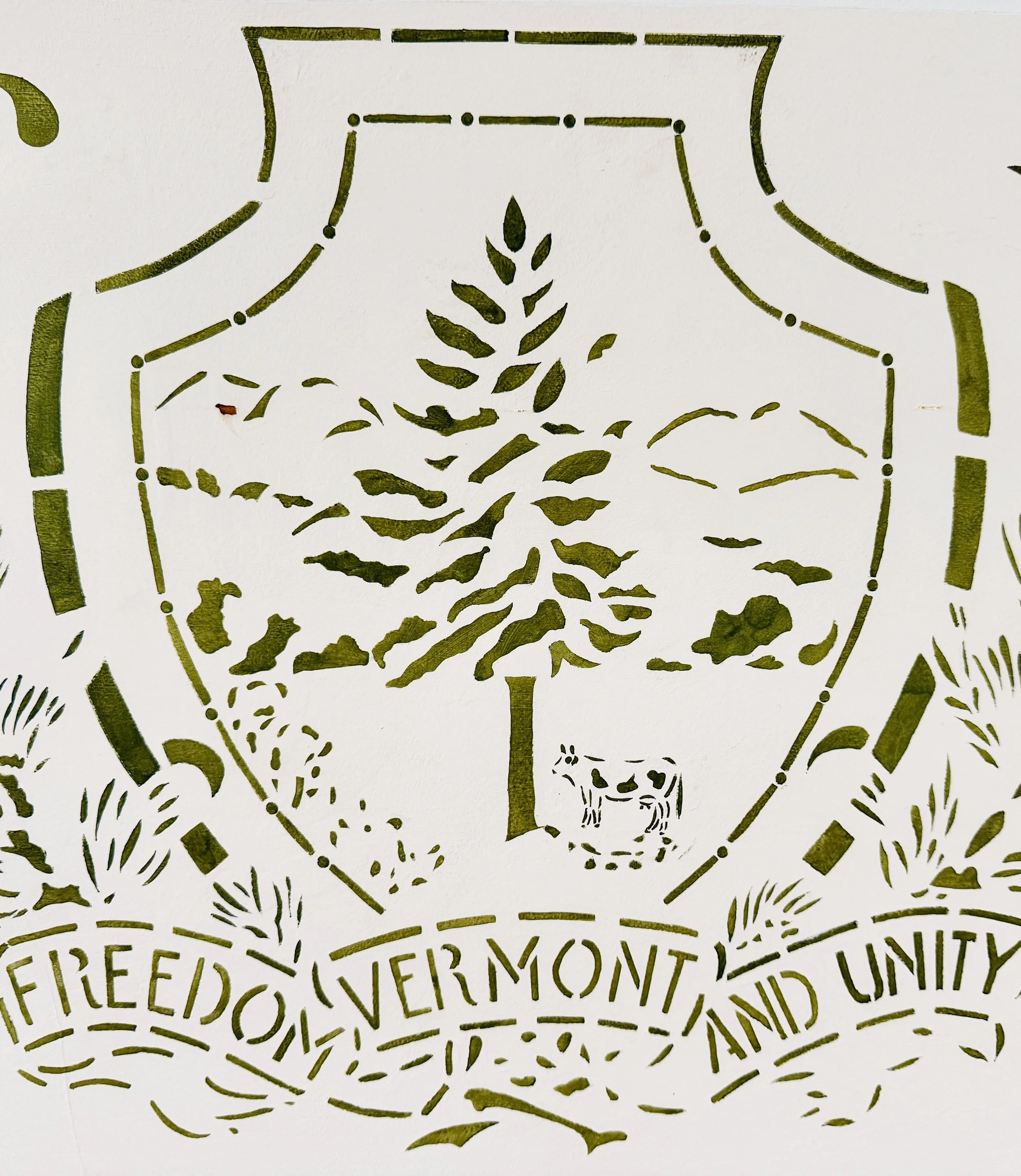
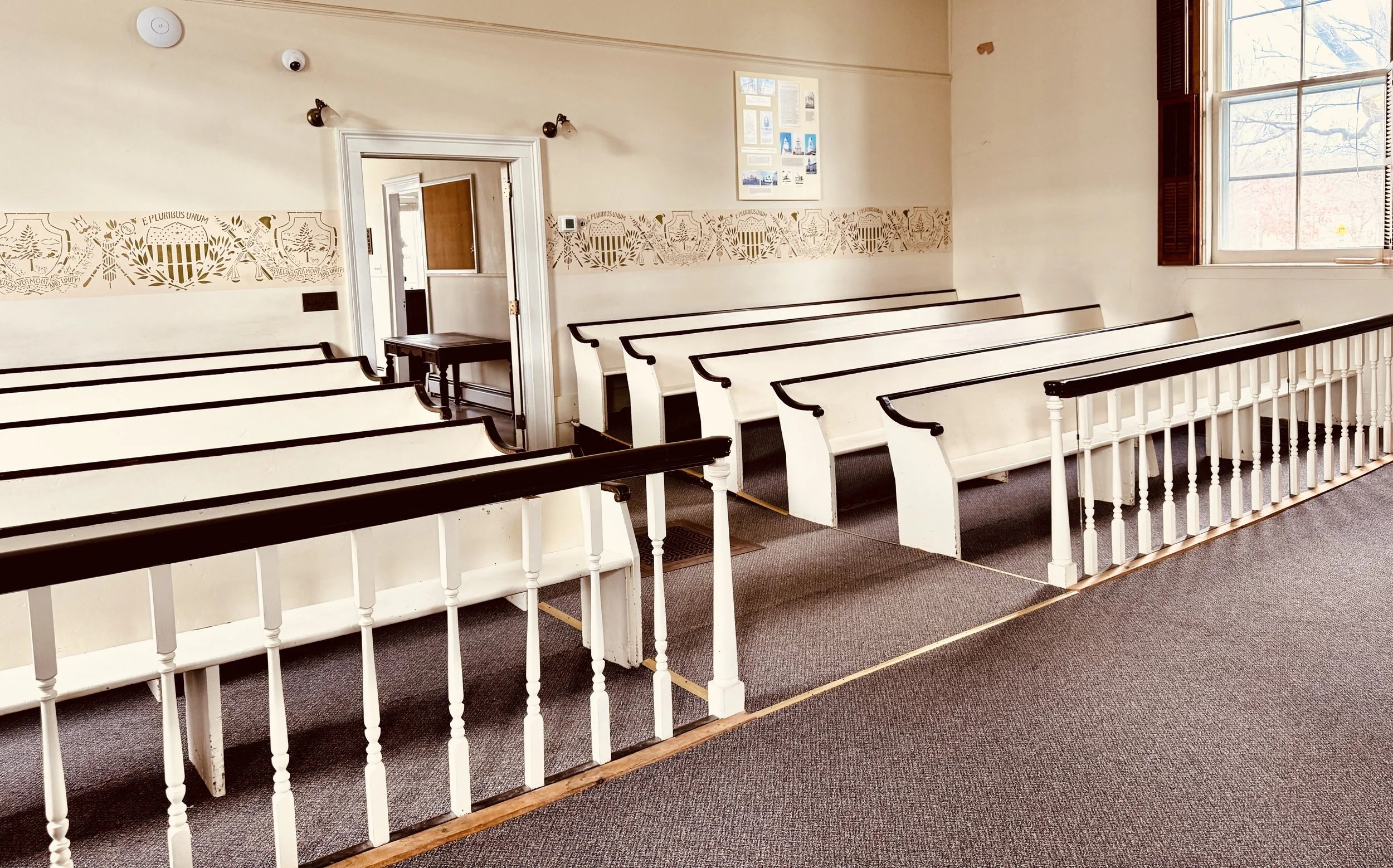
Contractor, Hiram Eggleston, placed crossbeams in the ceiling, and “decorating is complete, including a coat of arms of the state in the background above the judges’ heads – the original having been put there in the [18]’50s.”(3) This agrees with the later findings of experts who have discovered stenciling on the walls of the courtroom under the paint.
1942
The U.S. Coast and Geodetic Survey placed a benchmark on the top step of the entrance to state that, at that place, Manchester was 899 feet above sea level.
1954
Letters were nailed across the front of the building which say “Bennington County Court House” in gold. These were the work of local wood crafter Ferdinand “Nundy” Bongartz/
1987
Stencil expert Jessica Bond of Dorset, was asked by Probate Judge Margaret Dougherty to examine what she thought were relief designs visible through the paint on the back wall. “With the help of photographs taken by Mrs. Sara Larsen, Mrs. Bond was able to replicate the designs by laboriously tracing the original work and cutting stencils.” (3)
1990s
The gold-leafed octagonal bell tower was not always gold-leafed. It was only painted gold until a generous Equinox guest, Reynold Vincent Anselmo of Greenwich, CT, noted its poor condition and had it completely rebuilt, along with the exterior facade. (4)
1994
Bennington County’s assistant judges allocated $10,000 for repairs to the roof and tower of the Manchester courthouse and sought private funds to complete the work. They noted that the building must be made handicapped accessible, but updates were not made. (3)
Notable Events at the Courthouse: 1822 - Present
1822-1868:
The Court House served as the center of civic life in Manchester, hosting civic meetings, entertainments, town meetings, religious meetings and sessions of court. When in 1868, the Equinox House Music Hall was built, many of the entertainments moved to that venue.
1858-1880:
The northwest corner room on the second floor of the Courthouse was, for many years, used for a variety of private purposes. Charles Orvis had a dental office there in 1858-1859. From 1860-1872, Loveland Munson had a law office there, and when he became Town Clerk in 1865, that office shared the space. Munson would become one of Manchester’s most prominent citizens and Chief Justice of the Vermont Supreme Court. At one time, both the second floor west rooms were the offices of Munson and his law partner, Judge Elias Burton. In 1871, a Mr. Brownson operated a glove factory employing some twenty women and girls. It is believed that the company, or portions of it, occupied a room in the Courthouse. In the 1870s and 1880s, the basement space was given over to the Equinox barbershop.
1861-1865:
In July and August of 1861, a Union Army Civil War recruiting office opened officially in Manchester to enlist men of the Fourth and Fifth regiments of Vermont Volunteers. At least 50 men enrolled in the first wave, and patriotism ran high. “An assembly of citizens gathered at the courthouse to take measures to provide for the wants and comforts of men volunteering in Manchester. The public was called upon to subscribe funds; the parts of uniforms not furnished by the government were to be made by Manchester ladies.”
After the disaster at Bull Run, two more regiments were called from Vermont….100 men were quickly recruited from the Northshire. “The company was rendezvoused at Manchester Village, fed at Vanderlip’s, and those who did not go home nights were lodged in the Court House…when it came time for the “Guards” to join the rest of the regiment for the St. Albans’ muster, they formed opposite the Equinox House, and the order of the march was given.” This then was the ill-fated Company E, Fifth Regiment, First Brigade, raised from Manchester. It was composed mostly of young unmarried men who averaged nearly 25 years in age and five feet eight inches in height. They took the name of “Equinox Guards” in honor of Manchester’s mountain.
Company E participated in 25 battles and fifteen major engagements, some of which were Gettysburg, Fredericksburg, Antietam, and Rappahannock Station. But in June 1862, the entire regiment at Savage’s Station (Richmond), Virginia, in half an hour suffered the greatest loss of men killed and wounded ever endured by a Vermont regiment in a single action. All but 7 of Company E, 5th Vermont Volunteers were killed, wounded, or taken prisoner.
Despite heavy losses by the Union Army from 1862-1865, town meetings at the courthouse repeatedly authorized increased taxes for additional funds to recruit men and support their families monetarily. Countless drives were organized to send food and provisions South. By 1865, the Vermont Division totaled nearly 7,000 men. The men continued to muster in Manchester, quartering in their own and private homes, in the Courthouse, and at Vanderlip’s hotel. Finally, news of Lee’s surrender came by telegraph in June of 1865. Mrs. Joseph Wickham, wife of the headmaster of Burr and Burton Seminary, wrote that “John [Branch, run-away slave-sexton of the Congregational Church] had leave to ring his bells all day. The intense joy of the land uttered itself…in shouts.” (2)
1870-1914:
Various efforts to abolish the two-shire system were introduced in the Legislature, in favor of “centering” the county in Bennington with the construction of a new courthouse there. Due to strong opposition from the Northshire, these proposals were defeated, based largely on the fact that the county had no title to the land or the building. A compromise settlement was reached in 1914 stating that the County could continue to hold Court sessions in the building, but in the event that County Court sessions were no longer held there, the building would revert to the municipality of Manchester.
1900-1916:
A huge rally organized by Sarah Cleghorn was held at the Village Courthouse to foster kindness to animals. This was styled on earlier efforts by Jessie Hawley, who organized the Manchester Chapter of the Society for the Prevention of Cruelty to Animals. (2) 1902: Manchester had a transportation crisis. A mass meeting was called at the Court House by Charles F. Orvis, Theodore Swift, and George Smith to consider and take action on a legislative bill which had been introduced by J.W. Fowler of Manchester. It was called “An Act to Incorporate the Bennington County Traction Company.” This was to be an electric railroad or trolley running from Manchester to Granville. The charter passed, with the proviso that the bill exclude all highways, streets, and land of the Village from its provisions. In the long run, the Traction Company did not raise sufficient capital for the rest of their plans, and the electric line was not built. An autobus began running between Bennington and Dorset in July 1916. (2)
1918:
In November 1918, World War I Armistice Day was reported in the Manchester Journal as, “the noisiest, happiest day that Manchester ever saw.” Some fifty decorated cars filed past the soldiers’ monument in the Village, stopping at the courthouse for band numbers and the singing of the national anthem. The pealing of bells continued all afternoon and all evening, and a huge bonfire lit up the golf course. (2)
1935:
The Manchester Outing Club organized in October 1935 at the Court House. This group immediately took charge of opening two ski trails near Deer Knoll on Mt. Equinox; flooded the Equinox House tennis courts to make a sheltered skating rink; completed a bobsled run on the Barnumville Road; and investigated the possibilities of getting a snow train for Manchester. It was an auspicious start….The Outing Club was renamed the “Manchester Winter Sports Club” and in 1936, it announced plans for the opening of a well-constructed and patrolled ski run on Bromley Mountain in the National Forest. This club was the predecessor to the Bromley Ski Club. (2)
1938:
Some 40 businessmen and women met at the Court House to discuss the possibilities of constructing a motor road to the top of Mount Equinox as another feature by which to entice the tourist trade. But in 1939 Dr. J.G. Davidson purchased a large tract of land on Mt. Equinox and two years later built the first link of a toll road to the top. The acquisition of all necessary land was completed by 1946 and the following year, the road was opened to the public. (2)
2019:
Until 2019, County Court Sessions continued to be held in Manchester. When the County finally consolidated all Court sessions in Bennington that year, ownership of the Court House reverted to the Town of Manchester, as required under a decision of the Vermont Supreme Court in 1914. The Town now owns what is thought to be the oldest, or one of the oldest courthouses in Vermont, and one of only two gold-leaf domed buildings in the State - the other being the State House in Montpelier.
Footnotes:
1. Manchester in Vermont History, by Carl M. Chapin, 1932, printed by the Manchester Historical Society. 2. A Pleasant Land Among the Mountains, by Bigelow and Otis, 1961, printed by the Selectmen of Manchester, VT. 3. Manchester Memories of a Mountain Valley, by Mary Hard Bort, 2005, printed by the Manchester Historical Society. 4. Images of America: Manchester, 2011, printed by the Manchester Historical Society. 5. The original meeting house in which the Council met, as well as the fledgling congregations of several local churches, was razed in 1829. A larger brick meeting house was constructed on that property. The brick meeting house was replaced in 1879, after the schoolhouse was moved to West Road and the existing Congregational church was built. 6. In digging the deep drain for the opening of Union Street and also foundations for the various buildings like the Court House that have since occupied the hallowed ground, many bones have been found. The latest discovery was in 1937 during an excavation in the Court House basement.